
From Past to Future The Inheritance of Methodism & Higher Education
by Rev. Cara Stultz Costello, President & CEO
What does it mean to be a United Methodist institution of higher education?
It is a question worth asking in a season when higher education is navigating unfamiliar terrain. Colleges and universities are being asked to explain their value, respond to changing expectations, and prepare students for a world that seems to grow more complex by the day. For institutions shaped by a religious tradition, there is also the question of what that tradition brings to the work of learning and formation.
 Our response begins with an inheritance that reaches back to the beginnings of Methodism.
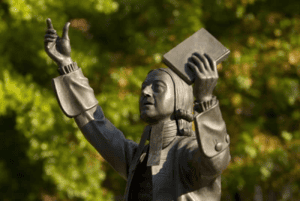
John Wesley understood education as part of the formation of a whole person. He encouraged reading, inquiry, and thoughtful engagement with the world. His concern extended beyond those who already had access to learning. In 1748, he enlarged Kingswood School near Bristol, England, which had been established for the children of coal miners. He envisioned an education that could open new possibilities for young people.
That vision crossed the Atlantic with the Methodist movement. In 1787, Thomas Coke and Francis Asbury established Cokesbury College in Maryland, the first Methodist college on the American continent. Its curriculum included languages, logic, history, geography, and astronomy. Coke and Asbury described their purpose as forming young people into “rational, scriptural Christians.” The college was supported through a denomination-wide collection, an early expression of shared responsibility for educating the next generation.
Cokesbury’s life was brief. Its buildings were destroyed by fire, and the institution closed in 1796. Yet the educational aspiration it represented continued. Across the nineteenth century, Methodist colleges took shape in a changing nation. The growth of Methodist higher education also unfolded amid struggles over who could enter its classrooms. Some colleges became places where women and Black students could pursue degrees at a time when many doors to higher education remained closed to them. This history is neither simple nor complete. But it reveals a tradition in which learning, faith, and the widening of opportunity have long been intertwined.
Our Wesleyan heritage invites us to bring faith into conversation with reason, experience, and the wisdom of others. It makes room for honest questions and careful discernment. “Test everything; hold fast to what is good,” Paul writes in 1 Thessalonians 5:21. Such an invitation asks us to approach the world with both conviction and curiosity, trusting that serious inquiry can deepen faith and enlarge understanding.
This is one of the gifts of a United Methodist education.
Today’s students are preparing to enter a world marked by rapid change, deep divisions, and challenges without easy answers. A Wesleyan approach to education holds intellectual rigor and spiritual formation together. It invites students to explore the complexities of the world while considering their place within it. It understands learning as more than preparation for a career. It is also preparation for a life of purpose, relationship, and service.
Luke’s account of Jesus growing “in wisdom and in years, and in divine and human favor” (Luke 2:52) offers a beautiful image of whole-person formation. At its best, education creates room for that kind of growth. It cultivates the mind, deepens the spirit, and helps students discover how their gifts might meet the needs of others.
May our colleges, universities, and seminaries continue to nurture students who are intellectually curious, grounded in faith, and attentive to the needs of the world. May they graduate with more than knowledge to carry forward. May they leave with the imagination, wisdom, and courage to put that knowledge to work in ways that bring healing, open doors, and transform lives.
That is an inheritance worth carrying forward.